Wait... Huh???
 Wifi… its in coffeehouses, lodgings and even fast food restaurants today. It's extending so rapidly that some individuals anticipate you won't require a wireless arrangement in the USA by 2020 because of how boundless the scope will be. No all the more taking it from the individuals nearby or strolling around searching for a sign on the grounds that you're going to overwhelm your arrangement limit. In the meantime you have most likely gotten disappointed at the moderate rates you confront when more than one gadget is taken advantage of the system. As more individuals add more gadgets with access to the remote web, stoped up wireless transmissions are going to make things deplorable. Indeed your most loved recreations will endure regardless of how incredible an arrangement you pay for. It is inexorable.
 With that chunk of discouraging news out, a German physicist named Harald Haas, who happens to be the seat of portable correspondences at the University of Edinburgh, has thought of an answer he calls:
"information through brightening –taking the fiber out of fiber optic by sending information through a LED light that differs in power quicker than the human eye can take after. "
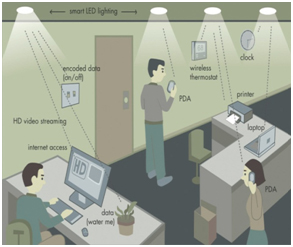
In the same way as other individuals Mr. Haas sees a future where information for laptops, advanced mobile phones, and tablets is transmitted through the light in a room. No, its not intended to supplant wifi. A snappy thought about our reality indicates how valuable it could be. What number of spots would it say it is "illicit" to utilize your wifi gadget? Doctor's facilities, planes and even some administration structures won't permit you to have your gadget on because of the affectability to radio waves. Light doesn't influence these things.
In case you're interested about the inward workings of this innovation I very urge you to look at the connection beneath and the references recorded. The one question that buoys up here is… shouldn't we think about security? How would you keep yourself sheltered from would-be character hoodlums or more terrible? As indicated by Haas "security would be snap – on the off chance that you can't see the light, you can't get to the information". That is just fine on paper. I figure this implies new innovation for window coatings and pass out curtains as well? I don't know how I'd feel in the event that I needed to detach myself so as to logon to online networking. What do you think? What's the following step?
Bibliography
Sana, G. R. (2012). Li-Fi (Light Fidelity)-The future technology In Wireless communication. International Journal of Applied Engineering Research, Vol.7 No.11. Retrieved fromhttp://www.academia.edu/4940306/Li-Fi_Light_Fidelity_-The_future_technology_In_Wireless_communication
Savage, N. (2014, November 20). Li-Fi Gets Ready to Compete With Wi-Fi – IEEE Spectrum. Retrieved 3 March 2015, from http://spectrum.ieee.org/telecom/internet/lifi-gets-ready-to-compete-with-wifi
Singh, R. K. (2015). Li-Fi-like System intended to bring 100-Gbps Speeds Straight to Your Computer. Retrieved from http://www.techworm.net/2015/02/li-fi-like-system-intended-bring-100-gbps-speeds-straight-computer.html
Citation (Sana, 2012), (Savage, 2014), (Singh, 2015)

No comments:
Post a Comment